
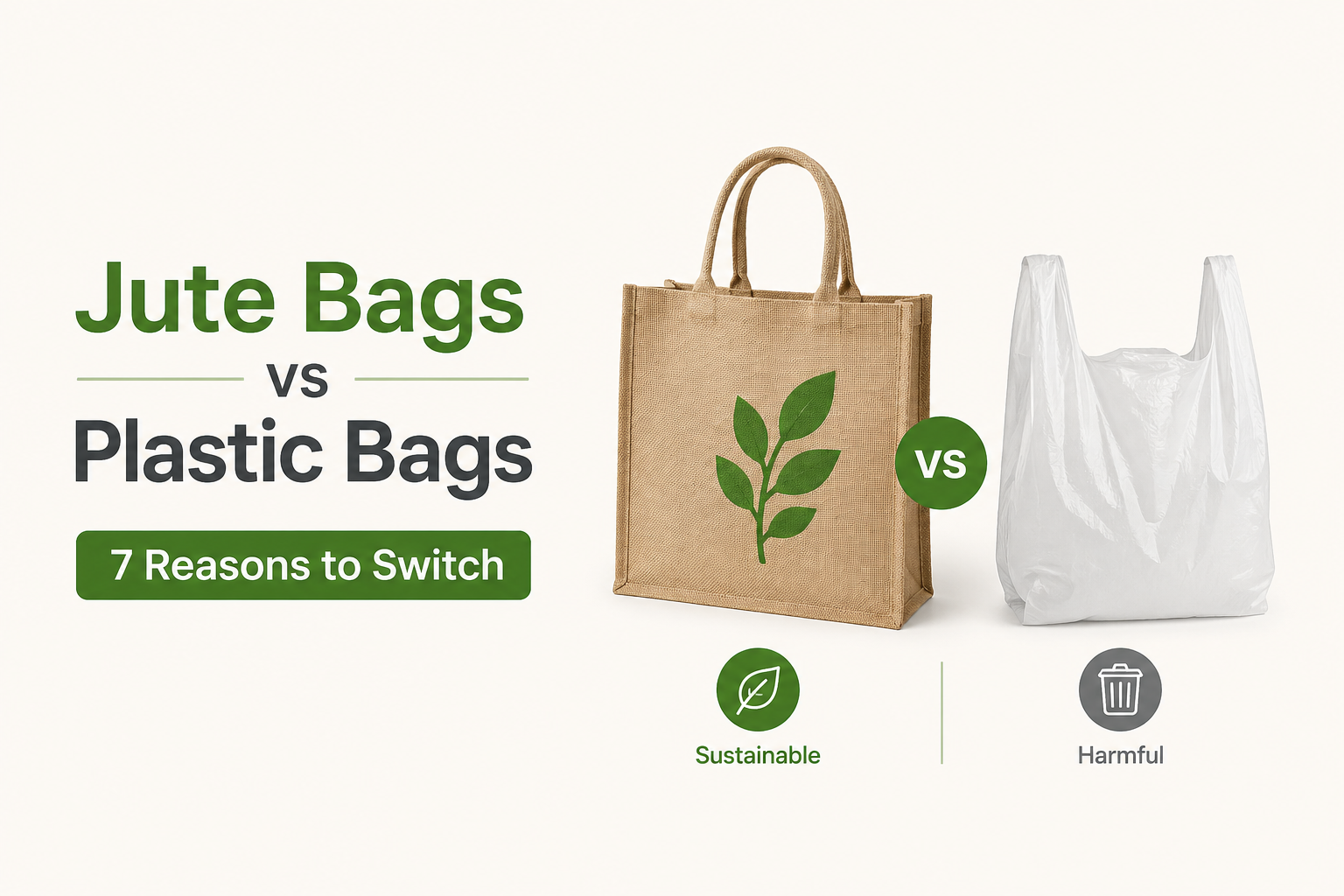
Jute Bags vs Plastic Bags: 7 Reasons to Make the Switch Today
You’ve probably used a plastic bag today. Or yesterday. Or both. Most of us have — it’s almost impossible not to. They’re handed to us at checkout, stuffed into our hands at markets, and tucked into deliveries without a second thought. But here’s the thing: that plastic bag you used for ten minutes this morning? It will still exist on this planet 500 years from now. Your great-great-great-grandchildren will inherit it. That’s not a metaphor. That’s just chemistry.
Jute bags won’t do that. And that’s just the beginning of why they’re better.
First, Let’s Talk About the Plastic Problem
Before we get into jute, it helps to understand exactly what we’re dealing with on the other side.
The world produces approximately 400 million tonnes of plastic waste every year. Of that, less than 10% is ever recycled. The rest ends up in landfills, in oceans, in rivers, in the stomachs of marine animals, and broken down into microplastics that have now been found in human blood, breast milk, and lung tissue.
Plastic bags are one of the worst offenders — not because they are the heaviest contributor by weight, but because of how they behave. They are lightweight enough to travel with the wind. They break apart into smaller and smaller fragments rather than decomposing. And they are produced in such colossal quantities — an estimated five trillion plastic bags every single year — that even a small improvement in how many we use has an enormous collective impact.
The good news is that switching away from plastic bags is one of the easiest, most accessible changes any of us can make. You don’t need to overhaul your lifestyle. You just need a better bag.
That’s where jute comes in.
What Makes Jute Different?
Jute is a natural plant fiber — one of the most widely grown crops in South Asia, thriving in the warm, humid conditions of the Terai lowlands. It has been cultivated and used for thousands of years. Long before plastic was invented, people were carrying things in jute. The plant grows fast, needs very little in the way of pesticides or fertilizers, and produces a fiber that is strong, flexible, breathable, and — crucially — completely biodegradable.
A jute bag isn’t a compromise. It isn’t a lesser substitute for the “convenience” of plastic. It is genuinely, measurably better in almost every way that matters.
Here are seven reasons why.
Reason 1: Jute Bags Biodegrade. Plastic Bags Don’t.
This is the most fundamental difference and it’s worth sitting with for a moment.
A plastic bag thrown into the environment does not disappear. It photodegrades — meaning it breaks apart into smaller and smaller fragments under UV light. But the plastic itself never actually goes away. Those fragments become microplastics, entering soil, waterways, and food chains indefinitely.
A jute bag, left in the same environment, will fully decompose within one to two years. The fiber breaks down into organic matter that enriches the soil rather than poisoning it. No microplastics. No residue. No inheritance of pollution for future generations.
This single difference — the ability to return to the earth — makes jute categorically better for the planet than any plastic alternative, regardless of how “thin” or “biodegradable” the plastic claims to be.
Reason 2: Jute Grows Without Harming the Earth
The environmental cost of a product doesn’t begin when you throw it away. It begins when it’s made. And the story of how jute is grown is almost entirely positive.
Jute is one of the few commercially grown crops that actually improves the soil it grows in. Its root system fixes nitrogen naturally, reducing the need for chemical fertilizers. It requires significantly less water than cotton. It grows densely and quickly — typically reaching maturity in about 120 days — meaning it produces a large volume of usable fiber from a relatively small piece of land.
During its growth cycle, a hectare of jute plants absorbs approximately 15 tonnes of CO₂ from the atmosphere. For context, that is more carbon capture per hectare than most forests.
Plastic, by contrast, is derived from petroleum — a fossil fuel that must be extracted, refined, and processed in ways that generate significant greenhouse gas emissions at every stage.
Growing jute makes the air a little cleaner. Making plastic does the opposite.
Reason 3: Jute Bags Last Far Longer Than Plastic
Here is where the practical argument for jute becomes impossible to ignore.
A standard single-use plastic bag has an average useful life of 12 to 20 minutes. That’s the time between receiving it at the checkout and putting your groceries away at home. After that, it either gets stuffed in a drawer with forty other plastic bags or thrown straight in the bin.
A well-made jute bag, used regularly, will last three to five years — often longer. It is strong enough to carry heavy groceries, books, gym gear, or a laptop without tearing. It holds its shape. It can be spot-cleaned. And unlike plastic, which becomes brittle and unreliable over time, jute actually becomes more supple and characterful with use.
When you do the numbers, a jute bag isn’t just better for the environment — it’s significantly more economical over time. You buy one good bag instead of accumulating hundreds of disposable ones.
Reason 4: Jute Bags Are Safer for Your Health
This one surprises people.
Plastic bags — particularly older or lower-quality ones — can leach chemical compounds including BPA (bisphenol A) and various plasticizers into whatever they come into contact with. When food is stored in plastic bags, especially in warm conditions, this leaching accelerates.
Jute contains none of these compounds. It is a natural fiber with no synthetic additives, no chemical coatings, and no off-gassing. Carrying your groceries in a jute bag means your food isn’t sitting against a surface that is slowly releasing petrochemical byproducts.
For people who are health-conscious — or who simply prefer to keep their choices as natural and unprocessed as possible — jute is the obvious answer.
Reason 5: Jute Bags Support Real People and Real Livelihoods
Plastic bags are manufactured in fully automated facilities. They support very few jobs relative to the scale of their production.
Jute is different. The jute supply chain — from farming to processing to spinning to weaving to finishing — is labour-intensive at every stage. This isn’t a weakness. It’s one of its greatest strengths.
In Nepal and across South Asia, the jute industry supports millions of farmers, processors, and manufacturing workers. Every jute bag you buy is connected to a human chain of work — a farmer who grew the crop, a mill worker who processed the fiber, a craftsperson who shaped and finished the final product.
At TheKosha, our jute products are made entirely within Nepal. The fiber is sourced locally from the eastern Terai, and the bags are manufactured in our own factory, supporting local jobs and keeping economic value within the community rather than exporting it to an automated global supply chain.
Choosing a jute bag is a small act with a surprisingly long reach.
Reason 6: Jute Bags Are More Versatile Than You Think
One of the persistent myths about jute bags is that they are rough, scratchy, and purely functional — something you carry to a farmers’ market and then forget about.
Modern jute bags have completely outgrown that reputation.
Today’s jute totes are available in a wide range of designs, finishes, and sizes — from compact everyday pouches to spacious structured totes that work equally well for groceries, the gym, a day trip, or a weekend away. They can be natural and undyed, showcasing the warm golden-brown of raw jute fiber. Or they can be dyed in rich, earthy tones that make them genuinely beautiful objects to carry.
At TheKosha, bags like the Hold Tote, the Flow Tote, and the Core Tote are designed to be used every day in real life — built with reinforced handles, structured bases, and durable stitching that holds up to actual daily demands. The Patch Pouch is small enough for essentials but made with the same attention to quality.
These aren’t compromise bags. They are bags you’ll actually want to use.
Reason 7: Choosing Jute Sends a Message
Every purchase is a vote. This is not a cliché — it’s a description of how markets actually work.
When enough consumers stop accepting plastic bags and start reaching for natural alternatives, manufacturers adjust. Retailers adjust. Supply chains adjust. Policy follows behaviour at scale.
The shift away from single-use plastic is already happening — driven partly by regulation and partly by consumer demand. Countries across the world have introduced plastic bag bans or levies. Major retailers are rethinking their packaging. Brands built around natural materials are growing.
By choosing a jute bag today, you are not just making a personal choice. You are adding your weight to a shift that is genuinely changing the economics of how things are made and distributed.
That matters. More than it might seem in the moment of a single purchase.
The Simple Maths of Switching
Let’s put it plainly.
If you use a plastic bag five times a week and switch to a single jute tote that lasts three years, you will avoid using approximately 780 plastic bags. If everyone in a family of four made the same switch, that’s over 3,000 bags kept out of the environment — from a single household, over a single bag’s lifespan.
Multiply that across a neighbourhood, a city, a country, and the numbers become staggering.
The switch is not difficult. It costs very little. And it starts the moment you decide to make it.
A Final Thought
We are not asking you to overhaul your lifestyle, give up convenience, or make some grand sacrifice for the planet.
We are asking you to carry a better bag.
One that lasts. One that looks good. One that you can feel good about every time you reach for it. One that, when its long life is finally over, disappears back into the earth without leaving a trace of harm.
That’s it. That’s the whole ask.
And we think once you make the switch, you’ll wonder why it took you this long.
Browse TheKosha’s Jute Bag Collection
Ready to make the switch? Explore TheKosha’s range of handcrafted jute totes, pouches, and bags — made in Nepal, built to last, and designed for real daily life.
👉 Shop Bags & Totes | Explore Totes | Shop Pouches
Questions about our bags or materials? Get in touch — we’re always happy to talk jute.